
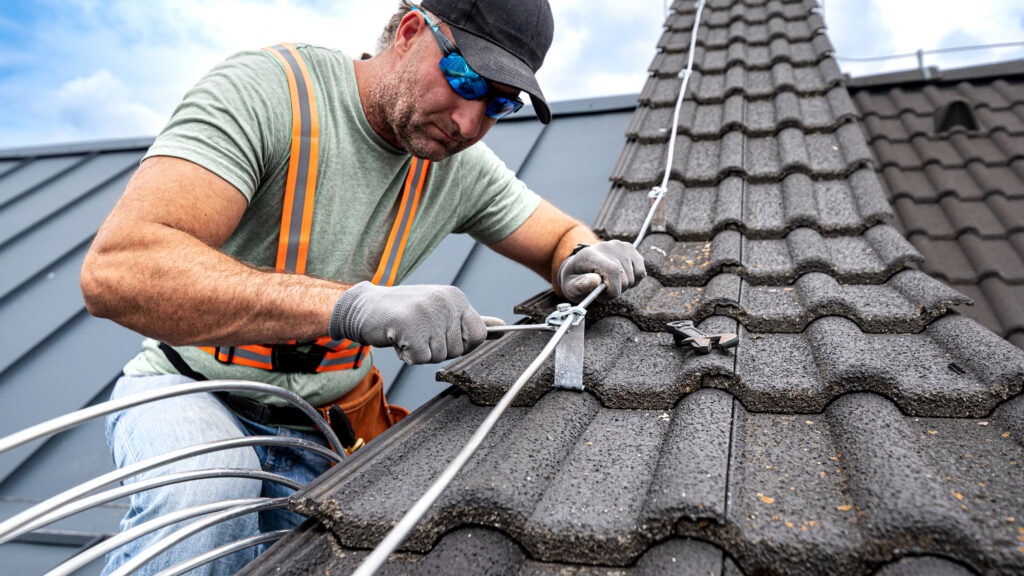
Lightning protection systems have been around for over 300 years. The idea of a lightning rod to provide a low-resistance path for electricity to reach the ground was pioneered by none other than Benjamin Franklin – the founding father of the United States – and his famous kite experiment.
Since then, the style, construction materials and designs have adapted, evolved and changed, becoming more effective and suited to their individual applications. In fact, although some people still use the term ‘lightning rod’ nowadays, most lightning protection systems are far more advanced than a simple metal stick. On this page, we’ll consider how this process continues even today, taking a look at some of the newest innovations in materials, design methodologies and integrated systems.
Materials
Over the years, the materials used in lightning protection systems have advanced significantly, providing better protection against the destruction left in the wake of lightning strikes. In the past, lightning rods were made of copper or iron. These widely available metals were effective electrical conductors. In other words, they were brilliant at ‘attracting’ lightning bolts, thus protecting the more important buildings and structures.
Unfortunately, though, they had a downside. Copper and iron are both naturally highly prone to corrosion, especially when left outside and exposed as lightning rods must be. Increased corrosion means more resistance in the metal, reducing the effectiveness of the lightning rod over time.
Today, engineers build lightning rods and protection systems from advanced materials such as aluminium, stainless steel and high-conductivity copper alloys. While these still conduct electricity very effectively, they’re far more able to withstand harsh environmental and weather conditions and much less likely to corrode. As a result, they’re ideal for modern lightning protection systems.
But it isn’t just lightning rods. Other components of lightning protection systems have also undergone significant material advancements. For example, the conductive cables that connect lightning rods to the ground are now made from highly conductive materials such as copper-clad or aluminium-clad steel. Furthermore, electrical engineers now design surge protection devices using metal oxide varistors and silicon avalanche diodes. These materials are highly responsive to surge events. They’ll (almost) instantaneously divert energy spikes from rogue lightning strikes away from sensitive equipment, preventing downtime, damage or fire.
Design methods and integrated systems
As technology advances and the need for safety increases, the design methods for lightning protection systems have also evolved – and improved – over the years.
Gone are the days when the traditional method of installing lightning rods on the roof of a building was the only option. Today, designs are more advanced, sophisticated and reliable. They involve various components, each meticulously devised and installed to divert electrical energy away from a building. These include an air terminal network, down conductors, earth terminations, interconnections and more.
One exciting recent development has been seen in computer simulations. System designers sometimes use advanced software to predict the behaviour of lightning strikes and optimise the setup. The result is a highly accurate and more efficient lightning protection configuration. The introduction of early streamer emission (ESE) technology is another significant innovation that’s proven more effective at intercepting lightning strikes than traditional lightning rods.

What’s next?
Lightning protection systems have been around for a long time, and they’ve constantly adapted to the world’s needs. With today’s advent of climate change and increased urbanisation, LPSs will continue to advance to counter the new threats.
Climate change is a significant factor in the development of next-generation lightning protection strategies. As weather patterns become more volatile, lightning protection systems will increasingly need to be able to handle extreme environmental events. For example, systems may need to be able to handle more frequent lightning strikes or more significant strikes with higher voltages.
We also might expect to see more dependence on materials with inherent lightning protection properties, such as carbon fibre or graphene. These materials reinforce structures and provide a more robust defence against lightning strikes.
Increased urbanisation also presents challenges and opportunities for lightning protection systems. As communities grow and cities become more densely populated, there is a greater need for lightning protection systems to protect multiple buildings and structures simultaneously. This may involve networked lightning protection systems that detect and respond to lightning strikes across an entire city.
Another potential direction is the development of smart lightning protection systems that can detect and respond to lightning strikes in real-time. These setups could integrate with other building automation systems to provide a comprehensive lightning protection solution.
Finally, we may even see a shift from lightning ‘diversion’ to lightning ‘prevention’. Current LPSs work by attracting lightning through a much less dangerous route. Work is underway to develop systems that guide lightning away from buildings without any physical contact, such as laser experiments conducted in the Swiss mountains, which could pave the way for new mobile lightning protection technology.
Lightning Protection Testing UK and you
Lightning Protection Testing UK is a nationwide company specialising in designing, installing and testing lightning protection systems. Although our offices are located in London and Darlington, we service the entire UK. There’s no job too small.
Does your business, church, hospital or heritage building need an updated lightning protection system? If so, we can help. Please don’t hesitate to reach out for a no-obligation chat about who we are and how we can offer assistance.
